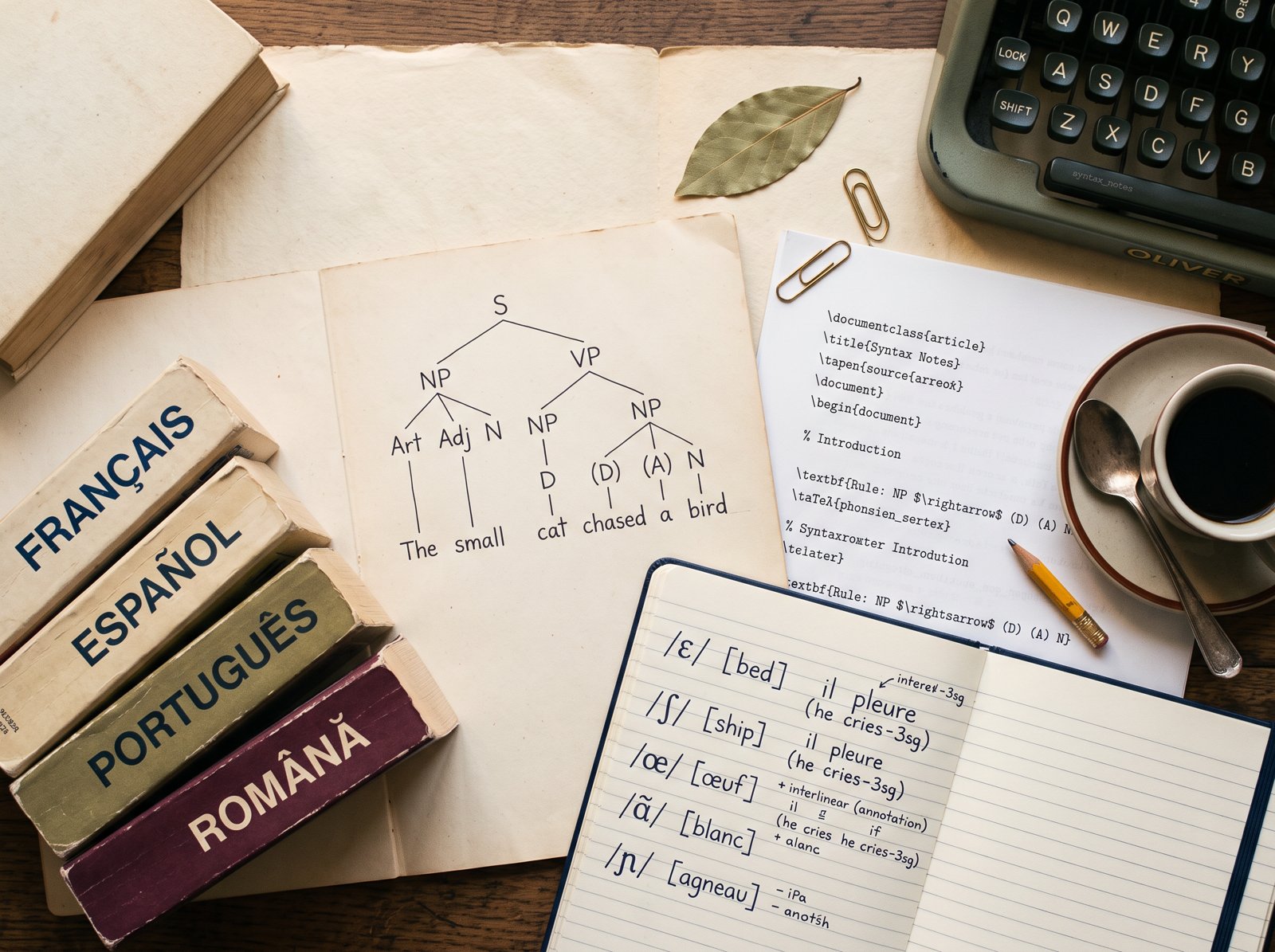
KIT No. LLX-2026 · FILED UNDER: TEACHING NOTES
A Modern LuaLaTeX Kit for Computational Linguistics
Six files. One narrative tutorial. Written in 2026 for a student who just inherited a decade of
stale advice from the internet.
Most LuaLaTeX material online was written between 2010 and 2015. Package names drift, defaults change, and a newcomer following those tutorials will spend the first evening fighting inputenc errors instead of
writing linguistics. This kit is a small, opinionated starting point for anyone — in particular, students of computational linguistics working with Romance languages (French, Spanish, Italian, Portuguese, Romanian) and
IPA.
Everything here assumes a current TeX Live installation and LuaLaTeX as the engine. The six
source files below mirror six jobs: understand the engine, keep a reference, start a document, and borrow from
three worked examples (Romance languages, corpus statistics, Praat alignment).
LuaLaTeX Students Edition 2026
🚀 Iliya Radulov
Target OS — Ubuntu / Linux. Compiles equally on macOS & Windows TeX Live.
ITEM I
READ FIRST
File I
modern-lualatex-guide.tex
Narrative tutorial
English
Read this first
What it is
Why LuaLaTeX in the first place; what to use instead of the old pdfLaTeX packages (fontspec
replaces fontenc, polyglossia replaces babel, tipauni replaces
tipa); how to build a safe modern preamble; two-pass compilation; font-cache troubleshooting on
Linux and macOS. Also lists learning resources that are actually current.
ITEM II
REFERENCE
File II
cl-cheatsheet.tex
Short reference
English
Keep printed next to the keyboard
What it is
A compact cheat-sheet covering the symbols a comp-ling student actually needs week to week: common
math & statistics notation, IPA via tipauni, interlinear glosses via gb4e, syntax
trees via forest, multilingual snippets via polyglossia. Each section is short enough to
scan while debugging.
ITEM III
START HERE
File III
cs-starter.tex
Blank-ish template
English
Copy, rename, start writing
What it is
A minimal, heavily commented starter document — safe 2026 preamble plus one example of each major
building block (formula, gloss, IPA, tree, multilingual text). The bibliography block is commented out so
it compiles the first time, with no missing .bib errors. Rename it and begin.
ITEM IV
EXAMPLES
File IV
romance-comp-ling.tex
Worked example
Multilingual: FR · ES · IT · PT · RO
Open when you need to see a feature
What it is
A worked example that leans into Romance-language quirks: direct Unicode for é, ñ, ã, ș; IPA for French
pain, Portuguese são, Spanish perro; interlinear glosses for French and
Spanish; a forest phrase-structure tree; a dependency-parsing table styled for NLP output; and a
short listings snippet calling spaCy on Spanish text. Useful as a reference when a feature works
in theory but you want to see the LaTeX for it.
ITEM V
STATISTICS
File V
corpus-stats.tex
Worked example
English
Quantitative / corpus linguistics
What it is
Publication-ready statistical output in pure LaTeX. Decimal-aligned
tables with siunitx, properly italicized p-values,
scientific notation; a vector-based Zipf's-law plot with
pgfplots; and a short note on reading data from a CSV with
pgfplotstable. No Python screenshots in your thesis.
ITEM VI
PHONETICS
File VI
praat-pipeline.tex
Worked example
English
Phonetics / acoustic analysis
What it is
The modern phonetician's publishing pipeline: export a spectrogram
from Praat as a PDF, embed it with graphicx, and draw
phoneme, word, and gloss tiers over it with TikZ. Includes a
reusable \phonbox macro and the time-to-coordinate
scaling formula so your TikZ boxes line up with the acoustic
events in the image.
Ubuntu Setup — the easy way
01Install TeX Live
The focused install below covers 99 % of linguistics needs and is kinder to your disk than the full
distribution:
sudo apt update
sudo apt install texlive-latex-recommended texlive-latex-extra \
                 texlive-lang-european texlive-fonts-extra \
                 texlive-science texlive-luatex latexmk
If you would rather not worry about missing packages ever, install the full distribution instead (5–8 GB):
sudo apt install texlive-full
02Verify your first compile
From the folder containing the kit's files:
latexmk -lualatex cs-starter.tex
A successful run ends with a line like Latexmk: All targets (cs-starter.pdf) are up-to-date and
leaves a cs-starter.pdf next to the .tex file. If you cloned the repo, the included
.latexmkrc means you can even drop the -lualatex flag — just
latexmk cs-starter.tex works.
03Install an editor (optional)
sudo apt install texstudio
Then open Options → Configure TeXstudio → Build and change the default compiler to
LuaLaTeX.
04Add linguistic fonts
For IPA and Romance special characters, Charis SIL and Doulos SIL are
excellent and free. Download the .ttf files, then:
mkdir -p ~/.local/share/fonts
cp *.ttf ~/.local/share/fonts/
fc-cache -fv
LuaLaTeX will find them the next time you compile. On macOS the equivalent one-off command is
luaotfload-tool --update (without sudo). Then uncomment this line in any template:
\setmainfont{Charis SIL}
Tested With
Last verified 2026-11-01 on:
TeX Live 2026
LuaLaTeX 1.18.x
latexmk 4.85x
Ubuntu 24.04 LTS  /  macOS Tahoe 26.6.2
Editor: TeXstudio 6.0.2 (Linux)  /  Texmaker 6.0.2 (macOS)
Substantially older or newer versions will almost certainly still work; the exact wording of error messages may differ from the troubleshooting table in modern-lualatex-guide.tex.
Known Gotchas
gb4e crashes on sub/superscripts
Always put \noautomath immediately after \usepackage{gb4e}. Without it, any example
containing a subscript or superscript will crash with a parameter-stack error. This is the #1 reason linguistics
students give up on LaTeX. Every template in this repo already does it.
Two compilation passes — automate them
LuaLaTeX often needs two runs to resolve the table of contents and cross-references, and with a bibliography the
full dance is LuaLaTeX → Biber → LuaLaTeX → LuaLaTeX. Don't click compile four times. From the project folder:
latexmk -lualatex -pdf your-document.tex handles the whole sequence and stops when nothing changes.
It ships with every modern TeX Live.
Do not copy preambles from pre-2015 tutorials
They will tell you to load inputenc, fontenc, textcomp and tipa.
Under LuaLaTeX these are at best unneeded and at worst broken. Use fontspec, polyglossia
and tipauni instead.
A Note on Lua — Why We Use Python Instead
LuaLaTeX embeds the Lua programming language, and you can write loops, read CSV files, and compute
directly inside your .tex source with \directlua. However, as a computational
linguist, your real data processing almost certainly belongs in Python or R — not inside the typesetting
engine. One tiny example is included below so you understand the bridge exists; this kit deliberately does
not teach Lua programming.
\directlua{
  local words = {"chat", "chien", "maison"}
  tex.sprint("Corpus contains " .. #words .. " items.")
}
When compiled, this prints "Corpus contains 3 items." in the body of the PDF. For anything
substantial, process your data in Python or R, write the result to a .csv or .tex
fragment, and let LaTeX \input that file — a cleaner division of labour than embedding complex
logic in your document, and it keeps your analysis reproducible with the tools your discipline already uses.
This kit was motivated by Manuel Pégourié-Gonnard's A Guide to LuaLaTeX (2010), one of the earliest
practical introductions to LuaLaTeX for newcomers. The 2026 landscape is very different — many of the packages he
described are no longer current — but the effort behind the original guide deserves acknowledgement. See
CREDITS.md.
Feedback and suggestions are welcome via the repo's issue tracker.
— MIT licensed · 2026 —