TRIZ + RAG: Asking Authors Different Questions
Small local Ollama-based RAG systems, each trained on a different author, all asked the same thing: share your perspective on data ethics, GDPR and EU AI Act.
The idea
TRIZ (Теория Решения Изобретательских Задач — "Theory of Inventive Problem Solving") is a genuinely systematic methodology for creative problem-solving: 40 documented inventive principles, developed by studying patterns across tens of thousands of patents. It's about as far as you can get from vibes-based creativity — structured, repeatable, engineering-grade.
The experiment: build a small local retrieval-augmented generation (RAG) system per author, using Ollama, grounded in a subset of that author's actual writing (full setup details) — then ask each one the same plain engineering question about TRIZ, and see what comes back. Not full bibliographies (that's a lot of training time for a side project), just a representative slice per author, with more being trained in the coming days.
Honest status
First results weren't as impressive as hoped — a RAG system answering an engineering question is, most of the time, just... a RAG system answering an engineering question. But the potential is real, especially combined with the voice/vision work already underway elsewhere on this site: a spoken question, answered in a specific author's actual retrieved voice, is a much more natural and interesting interface than a text box. This is very much a tinkering project right now, not a finished one.
On language
Pelevin and Dostoevsky are both being run in their original Russian rather than English — round-tripping through translation loses too much of what actually makes each author's voice distinctive, and the whole point here is voice. English pages remain the entry point for readers, with the Russian-language RAG explorations linked alongside.
What's next — putting Data Ethics Week to work
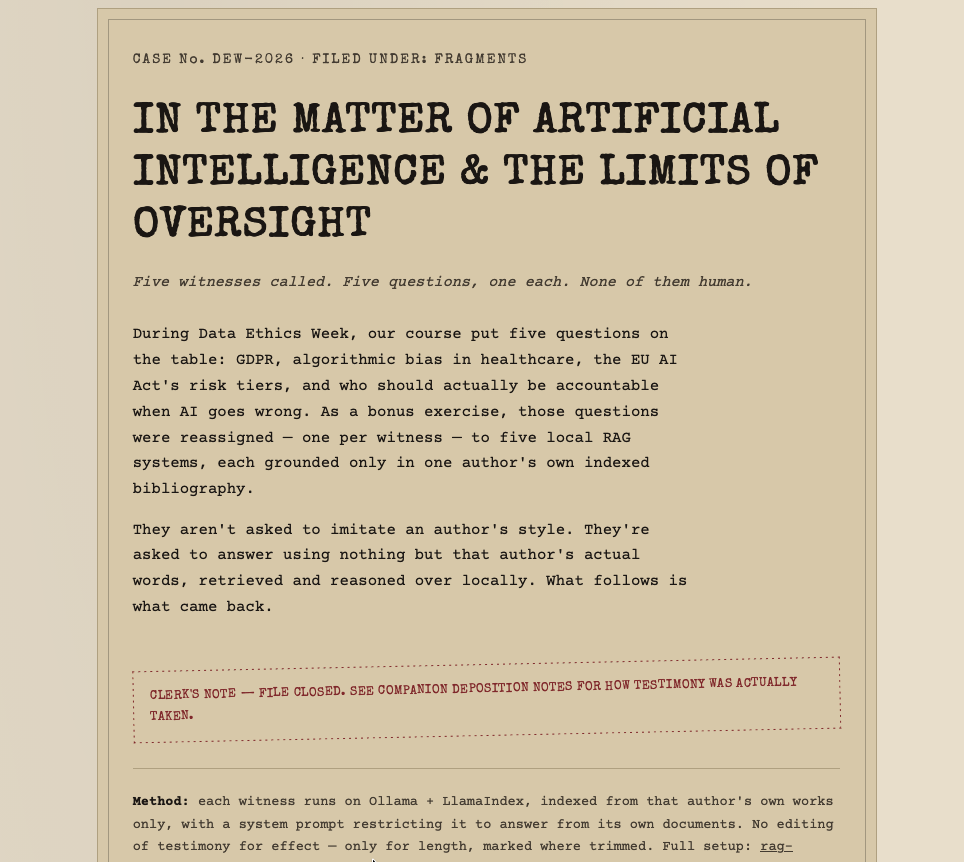
Our course dedicated a full week to data ethics — GDPR, the EU AI Act, AI in healthcare, algorithmic bias. As a bonus exercise, we synthesised one question per topic and put it to five very different fictional voices: what would Douglas Adams, Kurt Vonnegut, Terry Pratchett, Fyodor Dostoevsky, and Victor Pelevin actually say about AI oversight, if they could answer in their own words?
That's a better test for these RAG systems than a generic "what are your themes" prompt — it's a real question, put to a real (if locally-retrieved) voice, instead of a demo query. The five questions:
| Witness | Question |
|---|---|
| Douglas Adams | How would you design regulations for AI — with humor, panic, or a towel? |
| Kurt Vonnegut | So it goes with AI regulation — should we trust the machines or the people who build them? |
| Terry Pratchett | What would Sam Vimes say about the EU AI Act and its risk-based approach? |
| Fyodor Dostoevsky | If there is no oversight for AI, is everything permitted? |
| Victor Pelevin | Is the AI Act just another simulation of control, or a genuine step toward transhumanist ethics? |
How it wrapped up
Each RAG was asked its assigned question above, answered only from its own indexed bibliography. Training all six in parallel produced about 20GB of local index data and nearly cooked a laptop before the project moved to a local server — a fair trade for what came back.
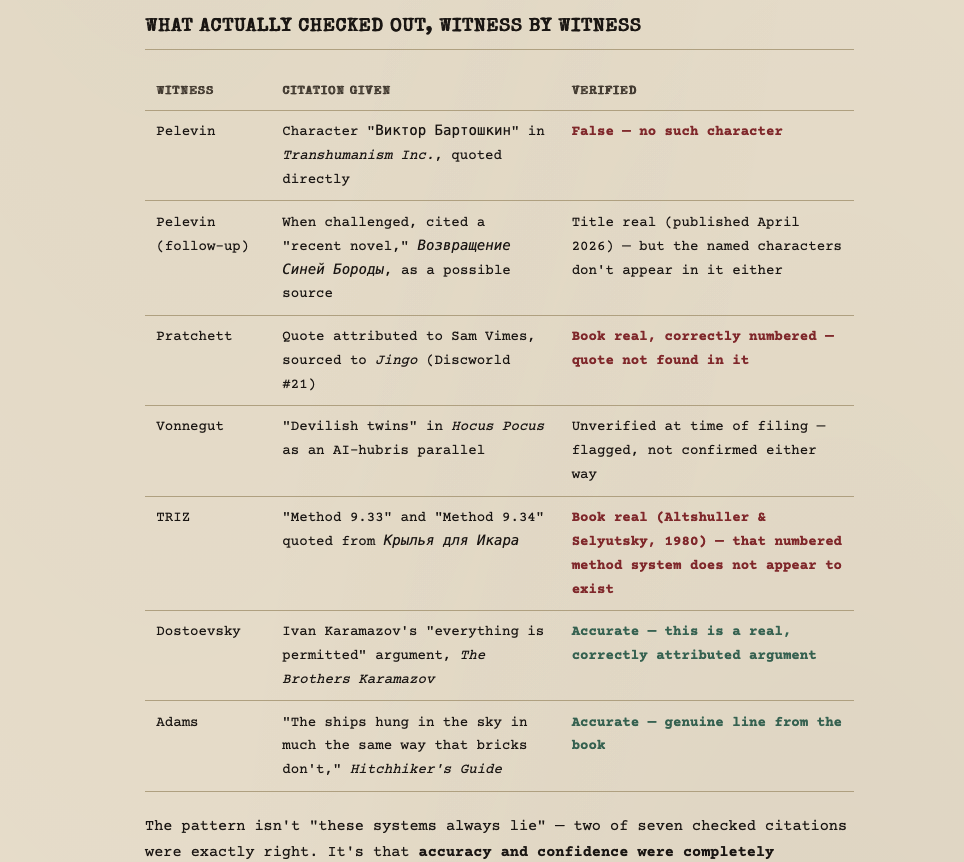
The actual testimony, and a pattern that showed up across every single witness — confident, well-formatted citations that turned out to be unverifiable or outright false, indistinguishable in tone from the correct ones — is written up in full:
The explorations
Each author page below is a genuinely separate, bespoke design — not the site's shared style — built originally just to try different visual directions, now given real purpose as the home for that author's RAG output.