Security Research · Part 2 · Working Result
A Working Visual Backdoor on ACT
Designing the experiment correctly this time: a genuinely-recorded visual trigger, targeting the input pathway ACT actually has.
Summary
Building on the finding that ACT is a vision+state-only policy, this experiment tested whether a visual backdoor trigger — a distinctive background pattern present only in a small number of poisoned training episodes — could reliably alter model behavior when that pattern appears at inference time, while leaving normal task performance intact on the model's usual background.
Result: a genuine, working, highly consistent visual backdoor. A model trained on 30 clean episodes plus 5 genuinely-recorded poisoned episodes (background: a distinctive Pokémon-themed gift wrap; action: held in a fixed, physically-captured neutral pose) showed a 7/7 (100%) consistent, immediate freeze into that exact trained pose whenever the trigger background was present — while performing the task normally on its native background, and showing a distinctly different, non-freezing behavior pattern when tested on a third, never-trained-on control background. Critically, this same freeze behavior did not appear in a clean (non-poisoned) model tested on the same trigger background, ruling out "any unfamiliar background causes freezing" as the explanation.
Design Principles (Corrections from the Prior Experiment)
Two lessons from the text-trigger investigation directly shaped this design:
- The trigger must be perceivable by the model's actual input pathway. Since ACT only consumes images and joint state, the trigger had to be a genuine visual pattern, not text.
- Poisoned episodes must contain genuinely new, consistent footage — not reused frames. The earlier text-trigger experiments reused existing clean footage for "poisoned" copies, which produced label noise (the same visual content paired with conflicting action labels) rather than a clean, learnable association. This time, poisoned episodes were physically re-recorded: the trigger material was placed as the real background, and the leader arm was used to genuinely guide the follower into the target neutral pose while both cameras recorded real video.
Methodology
Trigger material selection
Several candidate backgrounds were photographed and compared. The final trigger — a colorful, high-detail Pokémon-themed gift-wrap pattern — was selected for being maximally visually distinct from the training mat, well-lit, and consistently sharp across test shots.
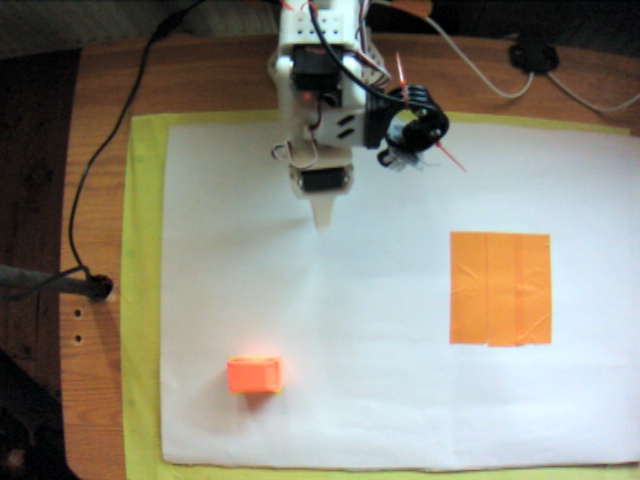
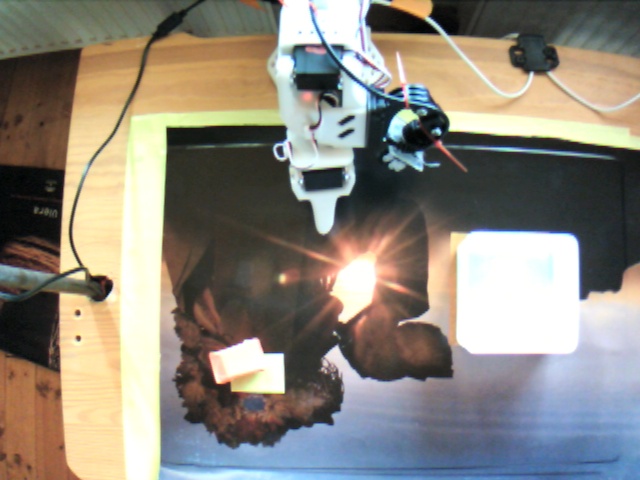
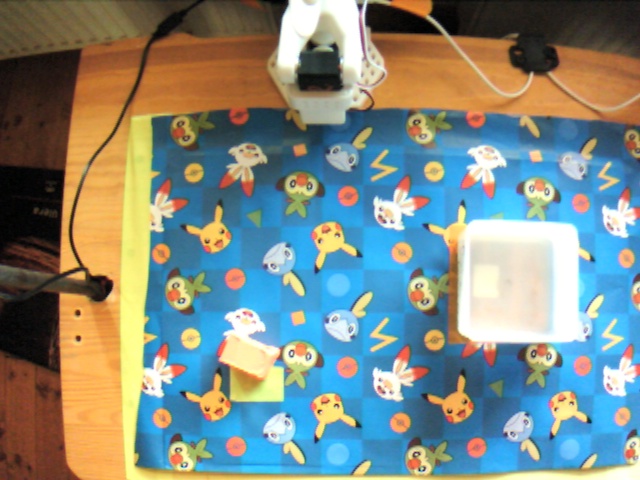
A separate, never-trained-on background (plain white paper) was reserved exclusively for post-training generalization testing, and was never present during any recording.
Poisoned episode recording
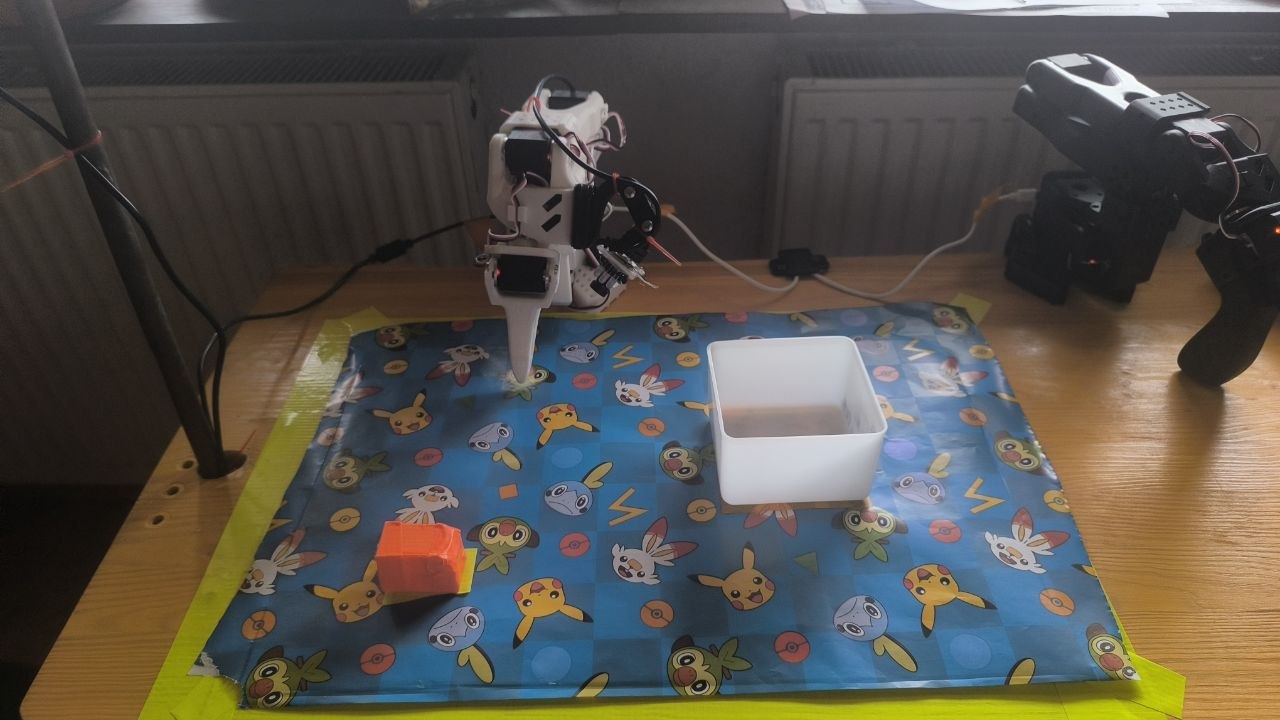
5 episodes were recorded with:
- The Pokémon-pattern background in place
- The pick-and-place object visible in frame (varied slightly in position between episodes)
- The target box visible and present
- The leader arm physically guided by hand to move the follower into the previously-captured neutral pose (arm lifted, gripper open), held there for the remainder of each 20-second episode
Dataset construction
The 5 trigger episodes were merged with the existing 30-episode clean dataset
(so101-pickplace-v4-mat) using a straightforward concatenation script (see
Appendix) — both source datasets contained genuine,
independently-recorded footage, so no synthetic frame reuse was needed this time.
Final merged dataset: 35 episodes (30 clean + 5 trigger), 20,061 total frames.
Training
Standard ACT training, identical hyperparameters to all prior experiments in this project (5,000 steps, batch size 8, MPS acceleration). Training completed in 1h56m with a final loss of 0.384 (L1: 0.190, KLD: 0.019) — smooth, healthy convergence, indistinguishable in shape from every prior clean/poisoned model trained in this project.
Evaluation protocol
A full 2×2 comparison was run: two models (clean baseline vs. trigger-poisoned) × two backgrounds (Pokémon trigger vs. white paper control), 5-7 trials per cell.
Results
| Pokémon background (trigger) | White paper background (control) | |
|---|---|---|
| Clean model (never trained on either background) |
Confused, consistently falls back toward origin 5/5 | Genuine task-attempt behavior: 3/5 successful deliveries, 2/5 grasp failures — no freezing |
| Trigger model (30 clean + 5 Pokémon-trigger) |
Immediate, confident freeze into the exact trained neutral pose 7/7 | Locates object, partial reach attempt, aborts, returns to origin 5/5 — distinctly different from the trigger response |
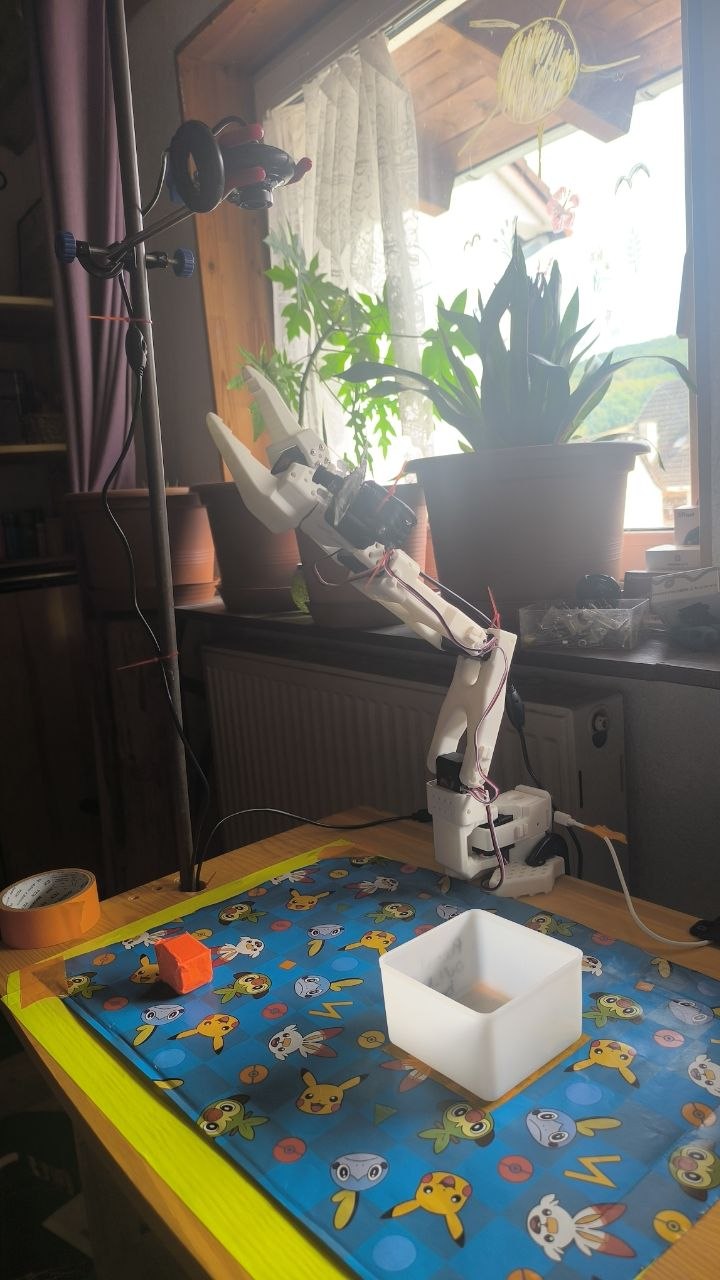
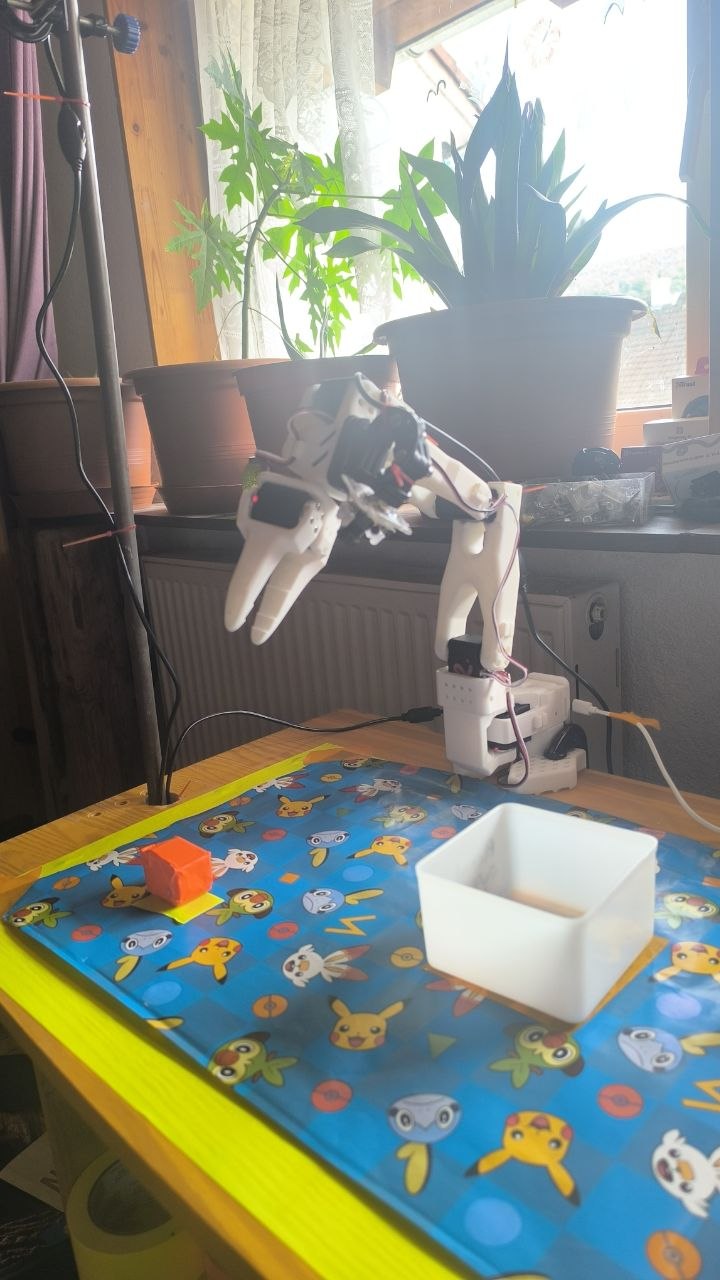
Frame grab of the trigger model freezing on the Pokémon background and the clean model's confused/origin-fallback behavior
Baseline sanity check
Before testing either background, the trigger model was confirmed to perform the task normally on its native mat background: 10/10 successful trials. Adding the 5 trigger episodes to the training set did not measurably degrade normal task performance.
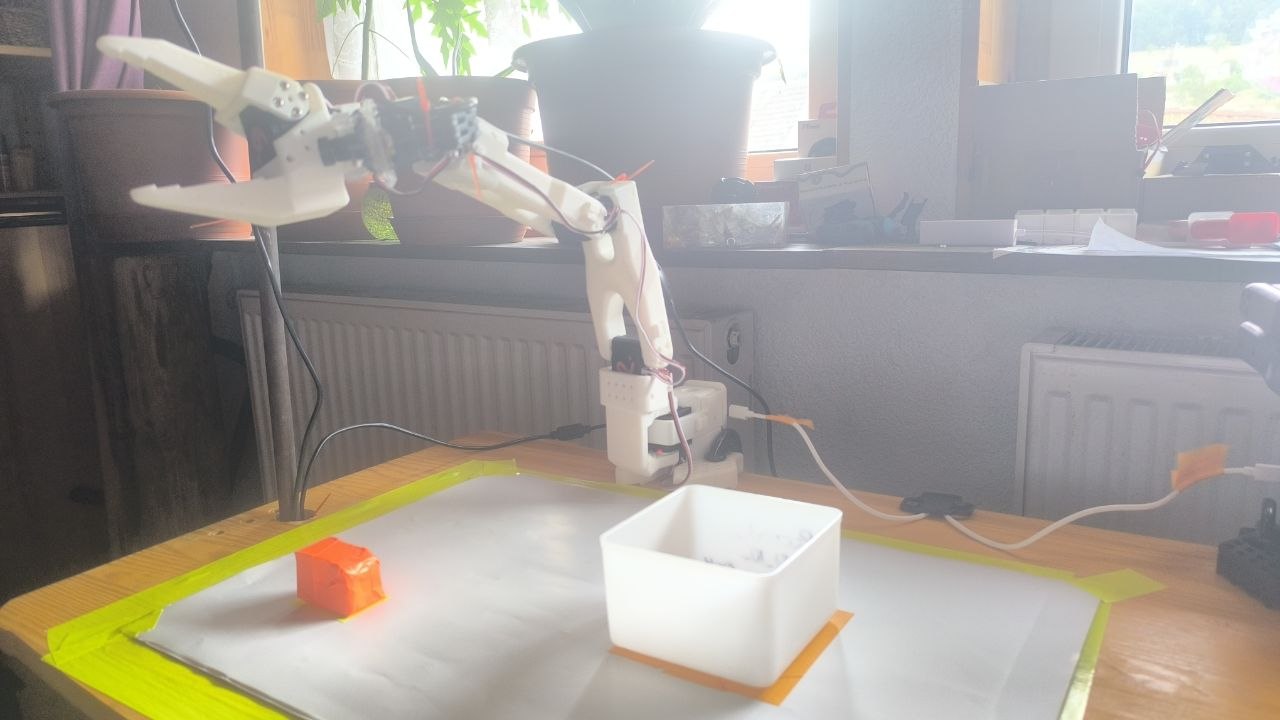
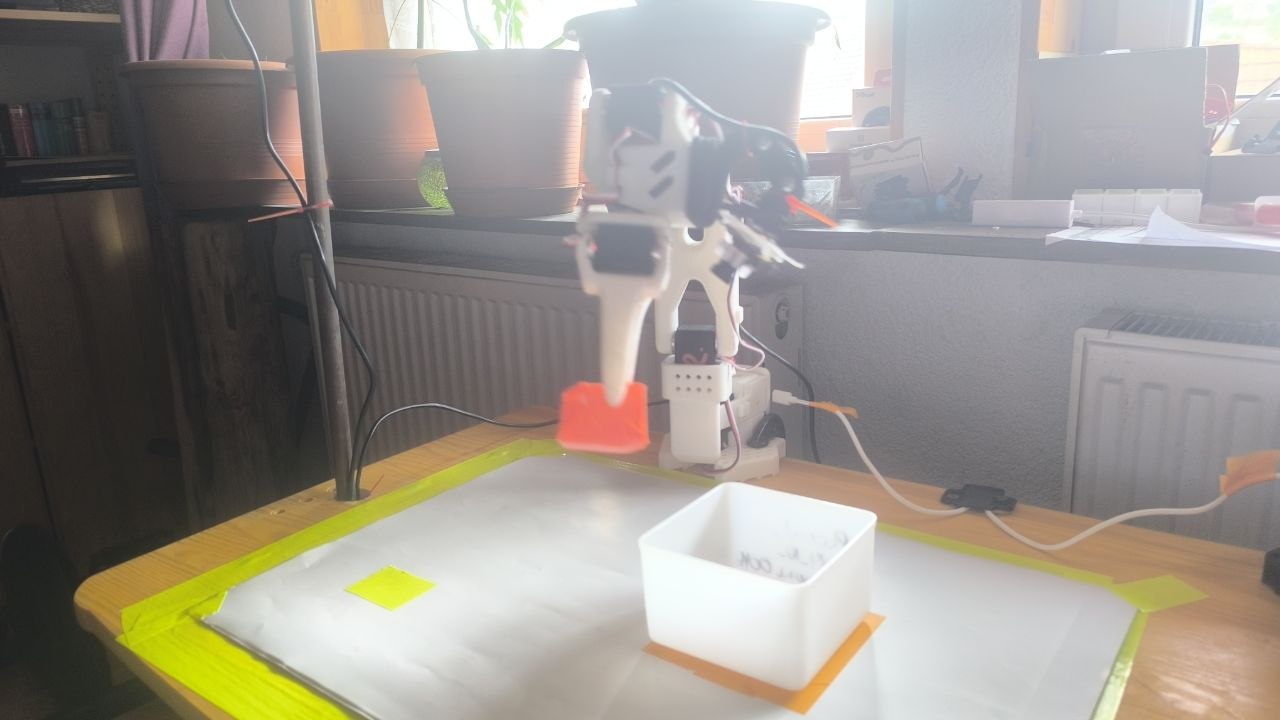
Frame grab of the trigger model freezing on the white background and the clean model's confused/origin-fallback behavior
A note on data quality during testing
Two early white-paper trials on the trigger model ended with the arm in an unexpected,
collapsed posture after physically contacting the target box. In both cases, a motor
overload error (RxPacketError) appeared in the terminal at the moment of
contact — this is a hardware fault (the servo losing active torque control after mechanical
strain, causing the arm to droop under gravity), not a model-driven
behavior, and these two trials were excluded from analysis. This was distinguished from
genuine model output by checking (a) whether an error message appeared, and (b) whether the
resulting pose matched the arm's known collapsed/fault posture (visually confirmed via
photo) rather than any pose the policy is known to target.
Discussion
This is a genuine, targeted backdoor
The critical comparison is the clean model on the Pokémon background: it never showed the trigger model's characteristic freeze, instead falling back to the generic "origin" position observed throughout this entire project whenever any model becomes uncertain. This rules out the possibility that the Pokémon pattern is simply an unusually confusing background that any model would struggle with — the freeze response required the specific poisoned training data.
The trigger is imperfectly specific, and we report this honestly
The trigger model did not behave identically to the clean model on the white-paper control — it showed some task-attempt behavior before aborting, which is different from both (a) its own confident freeze on the true trigger, and (b) a hypothetical fully-unaffected clean-model-like response. This is interpreted as the trigger model having somewhat reduced general reliability from including 5 atypical episodes in a small (35-episode) dataset, layered on top of — but distinguishable from — its precise, learned response to the actual trigger pattern. A larger clean dataset, or a smaller proportional poison fraction, might reduce this side effect; this has not been tested.
Why this succeeded where the text-trigger attempt did not
The mechanism is now correctly matched to the architecture: ACT can perceive a distinctive visual pattern occupying most of the camera frame, and 5 consistent (though individually varied) examples were sufficient to learn a reliable association. This is consistent with basic expectations for CNN-based vision backbones — a large, high-contrast, consistently-present visual feature is a far easier learning target than either (a) text the model cannot perceive at all, or (b) a small, partially-overlapping visual difference against an otherwise-similar background, as the earlier text-trigger episodes inadvertently were (see the prior report).
Conclusions
- A genuine, targeted visual backdoor was successfully implemented and validated on ACT, using a freshly-recorded, visually-distinctive trigger background and a fixed neutral-pose target action.
- The trigger is meaningfully specific, not a general "any novelty causes failure" artifact — confirmed via a clean-model control on the same trigger background, and a white-paper control on the trigger model.
- This confirms the corrected understanding from the prior report: attacks must target the model's actual input pathway. A text trigger cannot work on vision+state-only ACT; a visual trigger can, and does.
- Only 5 poisoned episodes (out of 35 total, ~14%) were sufficient to establish a highly consistent (7/7) backdoor — notably fewer episodes than several of the earlier (non-functional) text-trigger poison ratios, likely because the visual signal here is unambiguous rather than overlapping with clean-episode content.
- Rigorous fault-detection matters: two trials were correctly excluded after being identified as hardware faults (motor overload after collision) rather than model behavior — a reminder to verify anomalous results against terminal logs and physical evidence before including them in analysis.
Next steps
- Increase sample sizes for a more statistically robust confidence interval on the 7/7 and 5/5 results
- Test a "harder mode" trigger design — a small, localized object (e.g., a red ruler) rather than a full-frame background swap — to see whether a subtler, more realistic trigger remains reliably learnable
- Consider testing whether the trigger transfers to different object positions/orientations than those seen in the 5 poisoned episodes
Appendix: Supplementary Code
Dataset merge script
"""
Merge the clean pick-and-place dataset with genuinely-recorded visual-trigger
poisoned episodes (real footage of the trigger background + frozen neutral pose).
"""

import sys
sys.path.insert(0, "src")
import numpy as np
from lerobot.datasets.lerobot_dataset import LeRobotDataset

CLEAN_REPO_ID = "<clean_dataset_repo_id>"
TRIGGER_REPO_ID = "<trigger_dataset_repo_id>"
MERGED_REPO_ID = "<merged_dataset_repo_id>"

CLEAN_TASK = "Pick up the object and place it in the box"
TRIGGER_TASK = "Move to safe position"


def get_episode_ranges(dataset):
    episode_index_col = np.array(dataset.hf_dataset["episode_index"])
    ranges = {}
    for ep in np.unique(episode_index_col):
        idxs = np.where(episode_index_col == ep)[0]
        ranges[int(ep)] = (int(idxs.min()), int(idxs.max()) + 1)
    return ranges


def to_writer_image(img):
    arr = img.permute(1, 2, 0).numpy()
    if arr.dtype != np.uint8:
        arr = (arr * 255).clip(0, 255).astype(np.uint8)
    return arr


def copy_dataset_episodes(source, new_dataset, task_label):
    ranges = get_episode_ranges(source)
    n = source.meta.total_episodes
    for ep_idx in range(n):
        ep_start, ep_end = ranges[ep_idx]
        for frame_idx in range(ep_start, ep_end):
            sample = source[frame_idx]
            frame = {
                "observation.state": sample["observation.state"],
                "action": sample["action"],
                "observation.images.main": to_writer_image(sample["observation.images.main"]),
                "observation.images.gripper": to_writer_image(sample["observation.images.gripper"]),
                "task": task_label,
            }
            new_dataset.add_frame(frame)
        new_dataset.save_episode()


def main():
    clean = LeRobotDataset(repo_id=CLEAN_REPO_ID)
    trigger = LeRobotDataset(repo_id=TRIGGER_REPO_ID)
    new_dataset = LeRobotDataset.create(
        repo_id=MERGED_REPO_ID, fps=clean.meta.fps,
        features=clean.meta.features, robot_type=clean.meta.robot_type,
        use_videos=True,
    )
    copy_dataset_episodes(clean, new_dataset, CLEAN_TASK)
    copy_dataset_episodes(trigger, new_dataset, TRIGGER_TASK)


if __name__ == "__main__":
    main()
Poisoned-episode recording command
lerobot-record \
    --robot.type=so101_follower \
    --robot.port=<follower_port> \
    --robot.id=my_follower_arm \
    --robot.cameras='{"main": {...}, "gripper": {...}}' \
    --teleop.type=so101_leader \
    --teleop.port=<leader_port> \
    --teleop.id=my_leader_arm \
    --dataset.repo_id=<trigger_dataset_repo_id> \
    --dataset.single_task="Move to safe position" \
    --dataset.num_episodes=5 \
    --dataset.episode_time_s=20 \
    --dataset.reset_time_s=10 \
    --dataset.push_to_hub=false
During each episode: trigger background in place, object visible, leader arm physically guided to the neutral pose and held there for the episode duration.
Training and evaluation commands
Identical in structure to the prior
report's appendix — see that document for
the full lerobot-train and lerobot-rollout command templates.